

A liquid crystal polymer developed from polymer technology,
featuring excellent
thin-wall flowability and dimensional stability (low warpage)
SIVERAS™ LCP resin is an engineering plastic based on polyester resin. It realizes characteristics such as high strength, high modulus, and high heat resistance based on Toray's polymer technology, and its most significant feature is its excellent thin-wall flowability and dimensional stability (low warpage).
Features
High strength and high modulus
The thinner the molded product, the more highly the molecular chains are oriented, further improving strength and modulus.
Heat Resistance
It has excellent soldering heat resistance and can be safely used for SMT-compatible electronic components.
Dimensional Stability
There is no dimensional change due to water absorption, and the mold shrinkage rate and coefficient of linear expansion are small, enabling precision molding and excellent low warpage. In addition, the coefficient of linear expansion in the flow direction is comparable to that of metals.
Moldability
It has high flowability, making it easy to mold complex shapes. In addition, burrs hardly occur. It can be molded at a mold temperature of 100°C or lower, and excels in the degree of freedom of molding equipment.
Chemical Resistance
It has excellent resistance to many chemicals.
Flammability
We also have a lineup of products with high flammability.
Low Dielectric Properties
It has high electrical insulation and is excellent in high-frequency signal transmission.
Gas Barrier Properties
By highly orienting the molecular chains of the liquid crystal polyester resin, it exhibits excellent gas barrier properties.
Reasons to Choose
- High flowability suitable for injection molding
- Dimensional stability (low warpage) enabling high-precision molding
High flowability suitable for injection molding
Liquid crystal polyester resins, including SIVERAS™ LCP resin, generally maintain a liquid crystal state in
which molecules are regularly arranged even in a molten state. For this reason, there is little entanglement
between molecules, and it has extremely high flowability compared to other engineering plastics. In
addition, due to its characteristics, it is easy to mold small and thin parts, and is also suitable for
molding complex shapes.
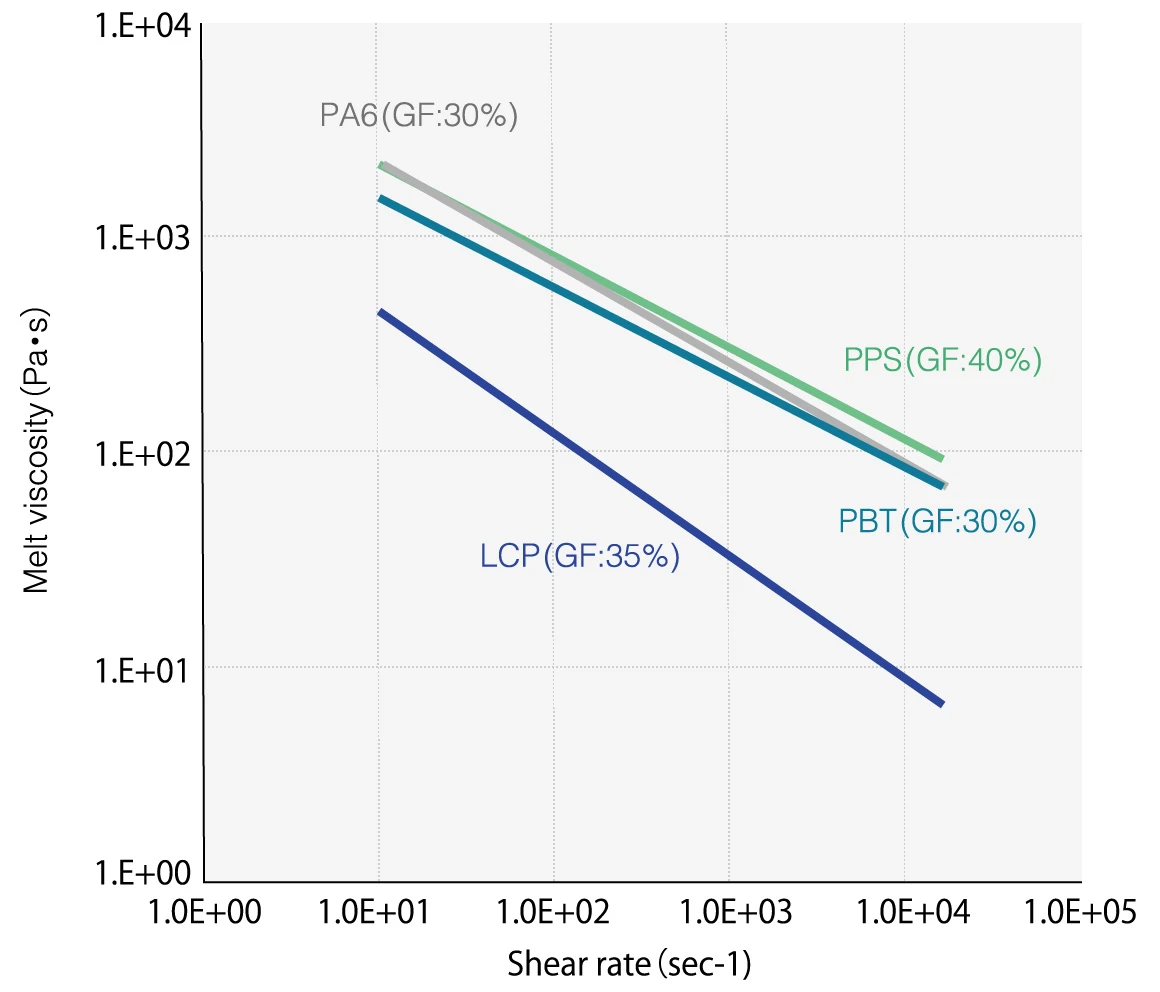
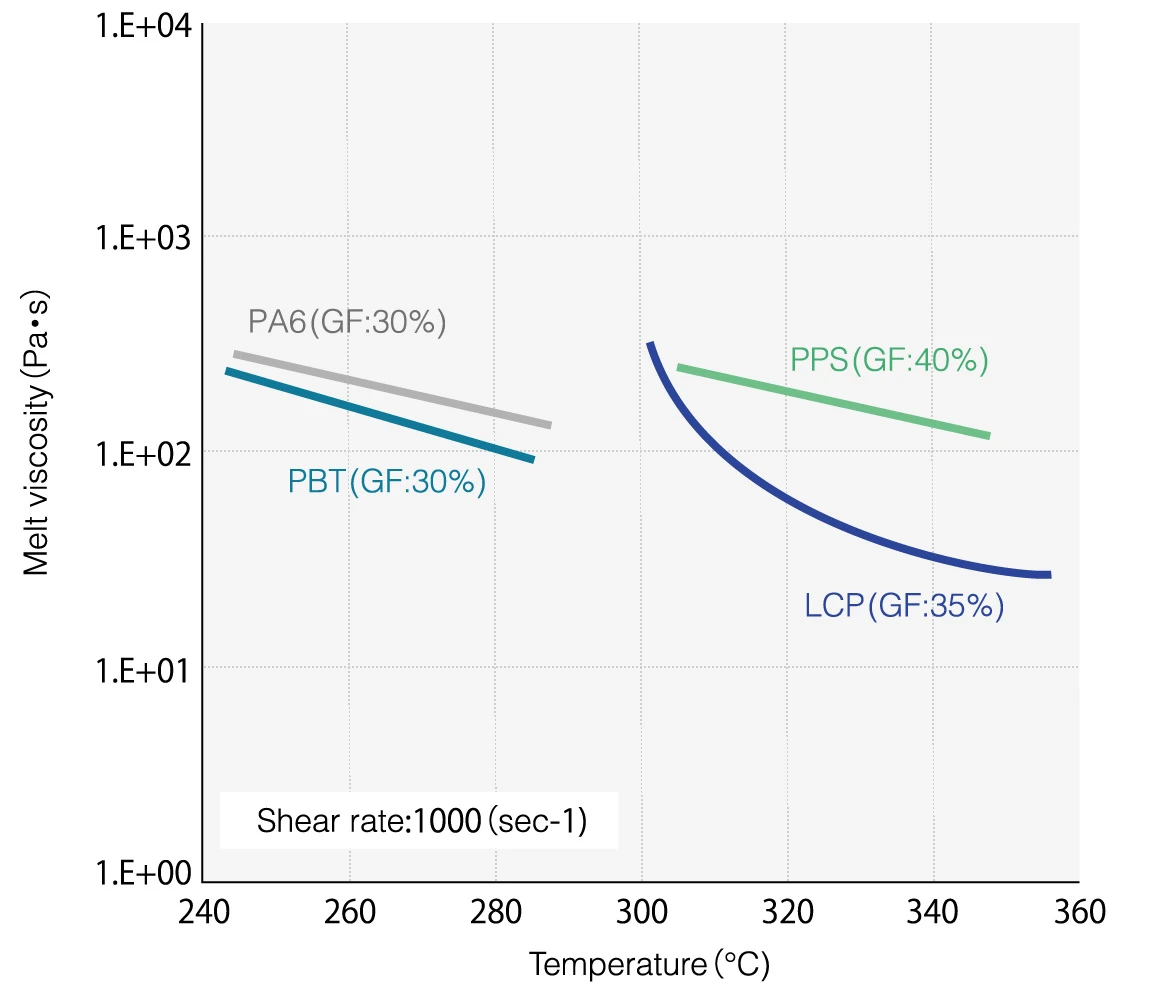
On the other hand, the flowability (melt viscosity) of liquid crystal polyester resin strongly depends on
temperature. In the temperature range of injection molding, the melt viscosity is low, showing good
flowability, while at the flow end (the final stage of injection molding filling), the melt viscosity
increases rapidly, so it also features extremely low occurrence of burrs. Therefore, it can be molded at a
low injection pressure even during injection molding, and the problem of warpage of molded products tends to
be less likely to occur.
Also, because the solidification speed is fast, injection molding in a short cycle is possible, making it
suitable for mass production.
Shear rate dependence of melt viscosity
Temperature dependence of melt viscosity
Dimensional stability (low warpage) enabling high-precision molding
The molecules of liquid crystal polyester resin have a feature of being easily oriented, so it is said that
the dimensional anisotropy is large, but this anisotropy can be greatly relaxed by compounding fillers, etc.
In SIVERAS™ LCP resin, this has achieved a lower mold shrinkage rate and coefficient of linear expansion
compared to other engineering plastics. Therefore, it can suppress deformation and warpage of products and
exhibit excellent dimensional stability. In addition, because it also has high heat resistance, deformation
and warpage are less likely to occur even in applications such as SMT*, and good products can be
obtained.
*SMT: Surface Mount Technology. A method of transferring solder to a board in advance, mounting electronic
components, and then soldering by heating.
Glass transition temperatures and melting points of various resins
| Material | LCP-GF35 LX70G35 |
PBT-GF30 1101G30 |
PBT-GF30 1101G30 |
PA6-GF30 CM1011G30 |
||
|---|---|---|---|---|---|---|
| Specific gravity | - | 1.66 | 1.65 | 1.55 | 1.36 | |
| Tensile strength | MPa | 175 | 205 | 145 | 185 | |
| Elongation | % | 3.0 | 3.8 | 5.0 | 5.0 | |
| Flexural strength | MPa | 220 | 280 | 195 | 260 | |
| Modulus | Gpa | 16.0 | 13.3 | 8.8 | 8.8 | |
| Izod impact strength | J/m | 90 | 155 | 90 | 125 | |
| Deflection temperature under load | ℃ | 255 | >260 | 217 | 215 | |
| Mold shrinkage rate | MD | % | 0.03 | 0.20 | 0.3 | 0.5 |
| 80×80×3mm | TD | % | 0.59 | 0.75 | 1.0 | 0.8 |
| Coefficient of linear expansion | MD | x10-5/°C | 1.0 | 2.3 | 4.1 | 2~3 |
| 80×80×3mm | TD | x10-5/°C | 1.5 | 3.2 | 4.9 | 2~3 |
For other details on product features and information on molding, please see Technical Information.
View Technical InformationApplications
SIVERAS™ LCP resin is used in various applications from electronic and electrical components to automotive components.
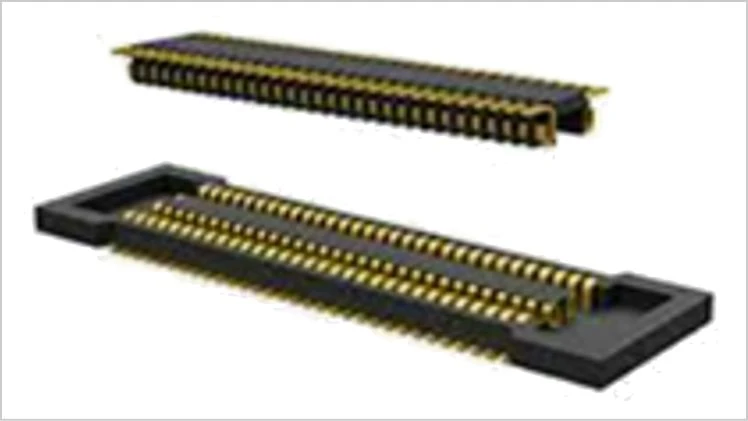
Ultra-compact precision connectors
Ultra-compact precision connectors used in the latest IT devices that are becoming smaller, such as tablet terminals and smartphones. Their raw materials are required to have high heat resistance, dimensional stability, and excellent flowability. SIVERAS™ has a large lineup of grades optimal for ultra-compact precision connectors, enabling optimal solution proposals.
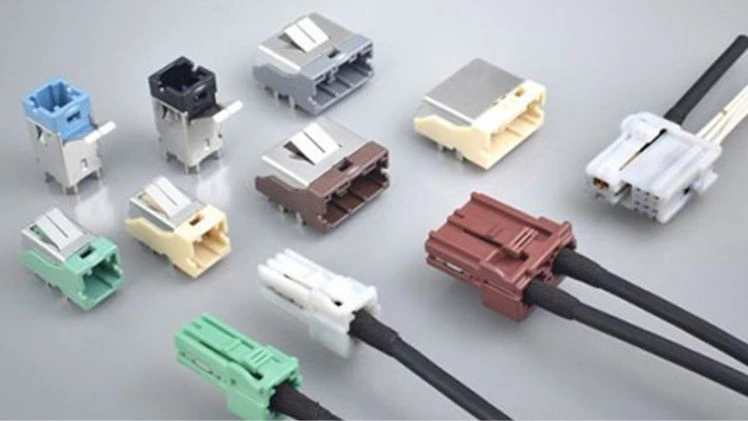
Automotive Connectors
Combining excellent mechanical strength in addition to heat resistance and dimensional stability, SIVERAS™ exhibits stable performance even in severe environments. Due to this high reliability, it is being increasingly adopted not only for electronic and electrical components but also for automotive components such as automotive connectors.
Toray's Proposals
Introducing technologies, methods,
and products that support advanced manufacturing

You can also view solutions that address product development challenges by field.
View Solutions
For those looking for the optimal material for their developed products


