
ECU (Electronic Control Unit)
Automotive ECUs (Electronic Control Units) play a core role in automotive electronic control systems, contributing to improvements in safety, fuel efficiency, and comfort. In recent years, with the advancement of ADAS (Advanced Driver Assistance Systems) and EVs (Electric Vehicles), higher performance and environmental resistance of ECUs are required. In addition, the integration of ECUs is progressing, increasing the importance of software. In the future, OTA (Over-The-Air) updates and cybersecurity measures will become essential, and it is expected that the demand for high-performance resin materials that realize heat resistance, insulation properties, and lightweighting will increase. By providing resin solutions that meet these demands, Toray supports the evolution of ECUs and contributes to the development of the automotive industry.
Integrated ECU
With the sophistication of automotive electronic control systems, the integration of ECUs is progressing. By integrating ECUs that were conventionally distributed individually into Domain ECUs, Zone ECUs, Central ECUs, Gateway ECUs, etc., it becomes possible to achieve system lightweighting, cost reduction, and efficient software updates. When ADAS (Advanced Driver Assistance Systems) ECUs are integrated, the heat generation problem of high-performance processors becomes apparent, requiring effective heat dissipation design. Toray's high heat resistance and high heat dissipation resin materials provide optimal solutions that support the evolution of next-generation ECUs.
Housing (Enclosure)
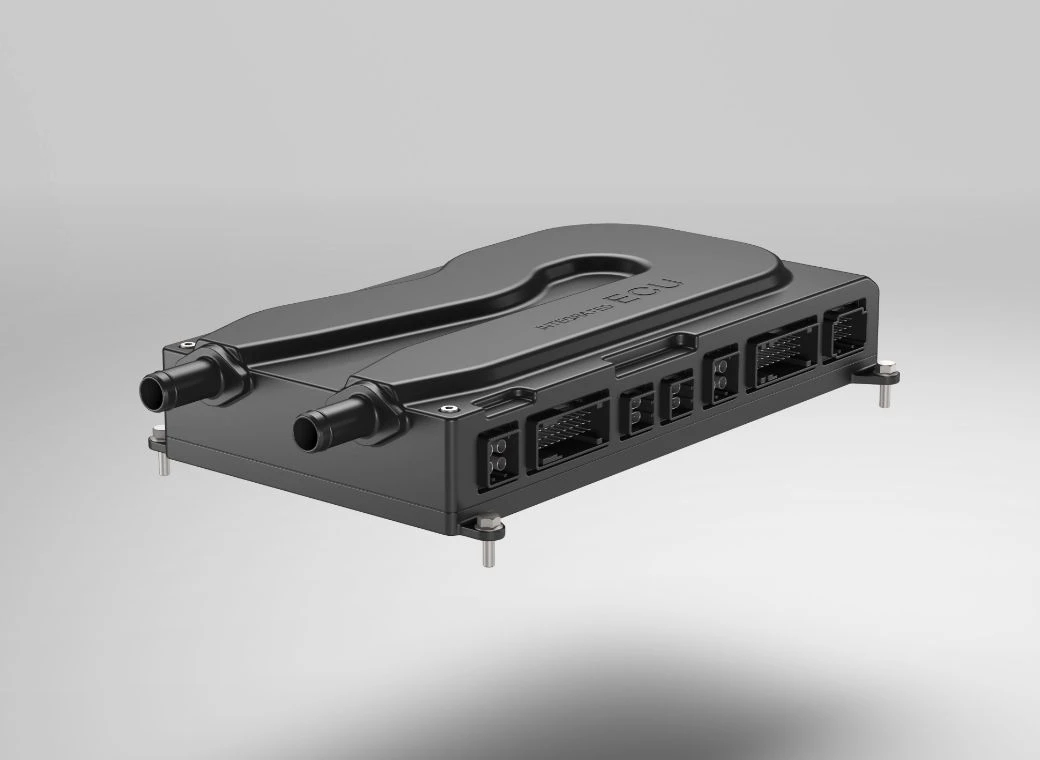
With the up-sizing of integrated ECUs, high-precision dimensional control is required. Especially during ADAS integration, heat dissipation measures become important, requiring materials with high thermal conductivity and heat dissipation design. In addition, to improve durability, strong bonding and airtightness using epoxy adhesives are indispensable.
PPS Grades
In addition to the high dimensional accuracy and chemical resistance (compatible with water cooling) specific to PPS, we have developed materials suitable for integrated ECUs, such as further increasing heat dissipation compared to general PPS.
PBT Grades
They have been adopted in all kinds of ECUs due to the highest dimensional accuracy among PBTs. We have also developed 7151GE-30, which is a recycled grade of 7151G30B.
It has been adopted in numerous ECUs as a material that balances dimensional accuracy, silicone adhesiveness, and fast molding cycle (productivity).
Cooling Mechanism
With the higher performance of integrated ECUs, cooling mechanisms such as air cooling (fans) and water cooling (resin flow paths) are adopted as countermeasures against heat generation. Through the provision of materials for air cooling fans and housing-integrated water cooling resin flow paths, Toray realizes lightweight and highly efficient heat dissipation, contributing to the stable operation of ECUs.
Grades
It is a highly rigid PPS resin that can reduce bending during high-speed rotation when applied to air cooling fans. It is known to minimize aerodynamic loss and improve blowing efficiency, and is adopted by many fan manufacturers.
It has the high dimensional accuracy and chemical resistance specific to PPS. Furthermore, we offer a lineup of materials endowed with flexibility that enables undercut molding suitable for manufacturing pipe-shaped molded products. A673MTB has already been adopted for resin inverter water jackets.
Shift-by-Wire ECU
Shift-by-wire is a technology that electronically controls conventional mechanical shifting, realizing improved accuracy of shift operations, lightweighting, and space saving. With the advancement of EVs and autonomous driving, free placement of shift levers and automatic shift control become possible, contributing to improvements in operability and safety. One of the core components of SBW is the ECU, which plays the role of instantaneously processing driver operation signals and controlling motors and actuators. In particular, fail-safe functions, heat resistance, and vibration resistance are required, and the selection of high-performance ECUs and their housing materials is indispensable. Toray's high-performance resins realize the downsizing and high heat dissipation of shift-by-wire ECUs, supporting the evolution of next-generation vehicles.
Housing
Shift-by-wire ECUs are required to balance high-performance boards and small housings. When boards become more high-performance, the amount of heat generated increases, making it more difficult to downsize components, but Toray stays close to customers and devises materials. We propose eliminating bolts by adopting vibration welding and achieving high heat dissipation by insert molding aluminum plates.
Grades
6207G-30 B
Through patented technology, this is a material that establishes high welding robustness and airtightness despite being a PBT resin. In addition to being excellent in vibration weldability, it enables the insert molding of aluminum plates for heat dissipation by adding heat cycle resistance. It has a wide track record of adoption in ECUs for suspension and chassis peripheral components.
This is a material that balances higher heat cycle resistance and hydrolysis resistance, which was considered a weakness in conventional PBT resins. We propose it when vibration welding is unnecessary by design.
Related Information

Download
PBT resin "heat cycle resistance formulation" and examples of utilizing Toray CAE analysis
TCU (Telematic Control Unit)
TCU (Telematics Control Unit) is an ECU that connects the vehicle with external networks and is responsible for communication and data management. In recent years, due to 5G compatibility and the evolution of V2X (vehicle-to-vehicle and vehicle-to-infrastructure communication), faster and larger-capacity data communication has been required, and the performance enhancement of TCUs is progressing. Along with this, downsizing and high-temperature countermeasures have become important, and the adoption of high-performance resins is expanding.
Housing
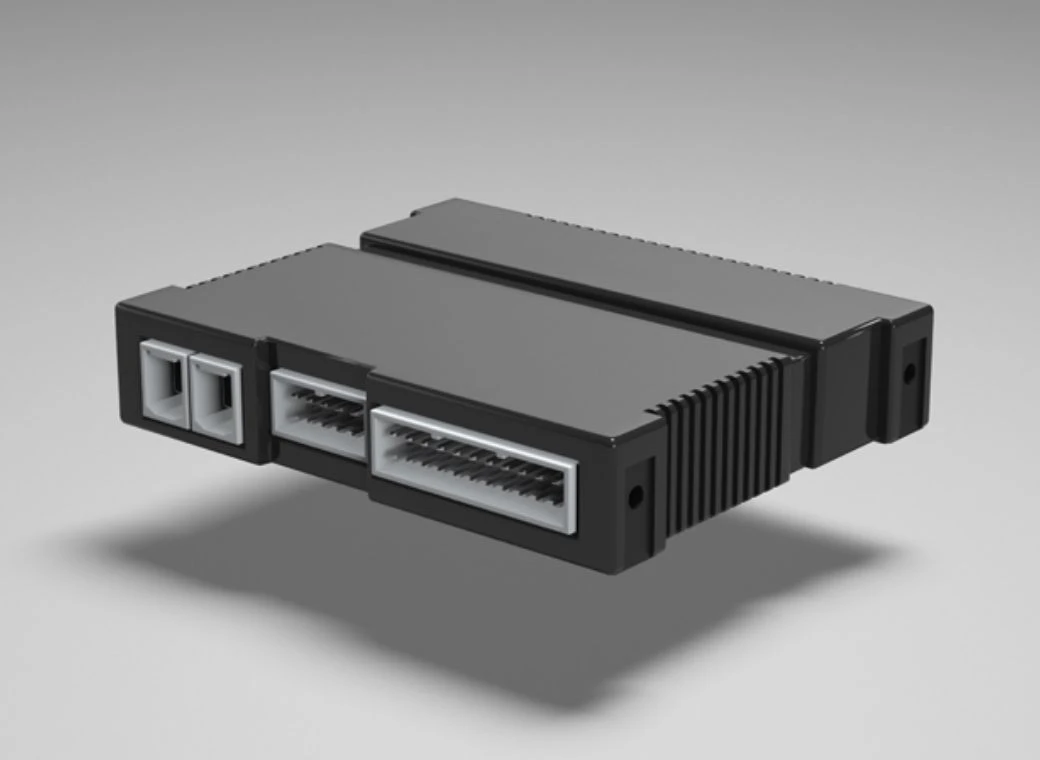
With the advancing utilization of 5G and V2X communications in TCUs (Telematics Control Units), countermeasures against heat generation due to high-speed processing are indispensable. Therefore, rather than general-purpose materials such as ABS, materials with high heat resistance having a melting point of 100°C or higher are required. Furthermore, because TCUs contain precision electronic components, high dimensional accuracy is important. Toray provides PBT that meets these demands and has already been widely adopted for TCUs.
Grades
These are materials that have been adopted in all kinds of ECUs due to the highest dimensional accuracy among PBTs. We can propose products produced locally worldwide.
In addition to dimensional accuracy, these are materials that meet flammability requirements, particularly in Europe. Also, by adding hydrolysis resistance, which was considered a weakness of conventional PBT, they are suitable for a wide range of mounting positions.
Related Information

Featured grades
Lineup of high dimensional accuracy materials for telecommunications equipment and sensor components

Download
You can view materials related to products and methods that support product development in the automotive industry.

Introduction Support
Our domestic and international technical support centers provide consistent support from resin selection to design, analytical evaluation, and follow-up after market launch.