
Development of optimal PBT and PPS resins for laser weldability
To improve quality and shorten manufacturing periods of high-performance device components
Mobility xEV High-performance devices Downsizing Laser weldability
Resin materials are increasingly adopted as high-performance devices become smaller, lighter, and more highly functional. At manufacturing sites, the utilization of laser welding is also increasing from the perspective of reducing loss and improving quality when joining molded products using resins. We have developed products optimized for high-performance devices and electronic components by improving the transmittance while maintaining the functions of PBT resin and PPS resin, which have conventionally been considered difficult to laser weld.
Are you experiencing these challenges?
- Want to laser weld PBT and PPS
- Want to enhance the design flexibility of laser welding of resin materials
- Want to shorten the takt time
for manufacturing high-performance device components
Toray's Proposals
Regarding PBT resin, which is increasingly adopted for electronic components, and PPS resin, which has
excellent heat resistance and chemical resistance, we have independently developed products for laser
welding equipped with high laser transmittance.
It contributes to improving design flexibility and reducing
costs.
Point 1
With high transmittance
suitable for laser welding
PPS and PBT
Point 2
Improves design flexibility
of resin welding
Point 3
Contributes to durability improvement
such as prevention of hydrolysis
Expanding use of laser welding for thermoplastic resins
As the downsizing, lightweighting, and higher functionality of high-performance device components progress
in fields such as mobility and industry, cases of adopting resins as materials are increasing. What is
important under such circumstances is the selection of the method for joining resins together. Generally,
methods such as using screws and adhesives, or applying rotation and vibration to weld with frictional heat
are used, but there were challenges such as shavings becoming loss, and the components themselves
potentially deteriorating due to strong vibration and pressure.
Therefore, what has been attracting attention in recent years is laser welding, in which thermoplastic
resins* are irradiated with a laser and welded by its heat. Its adoption is expanding due to
advantages such as being able to be done in a short time, being less likely to cause loss, and materials
being less likely to deteriorate. On the other hand, in the processing of PBT and PPS, which are often used
for electronic materials, it has been a challenge that it is difficult to adopt laser welding.
*Thermoplastic resin: A resin that softens when heated to its melting point. Besides this, there are also thermosetting resins that do not soften even when reheated.
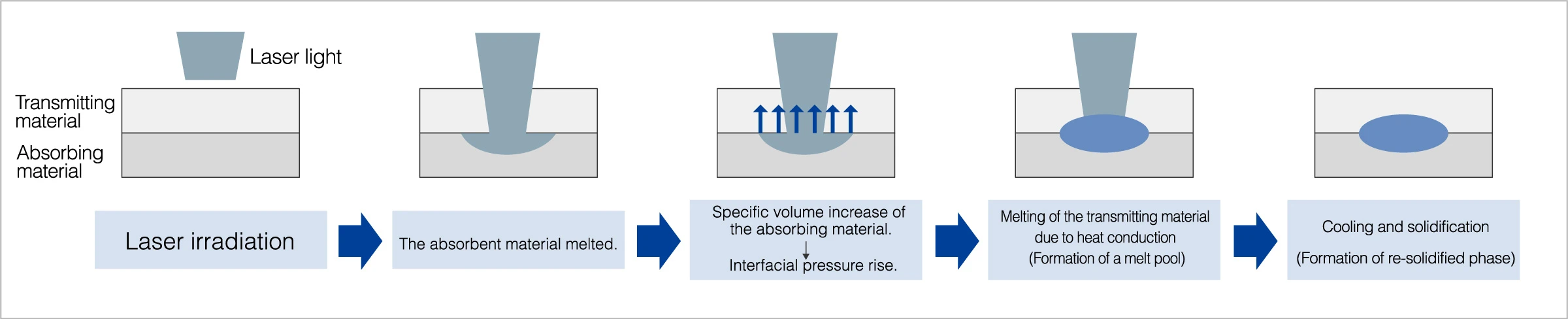
Principle of laser welding of resin
One of the resin molded products to be bonded is molded with a "transmitting material" having high light transmittance, and the other with an "absorbing material" that absorbs light, and the laser is irradiated from the transmitting material side in a state where the two are combined. As a result, the surface of the absorbing material first heats up and melts, and the heat is transferred to melt the surface of the transmitting material, so that they can be welded by cooling at the end. Because the melting range remains at the joint surface of the resin, distortion of the molded product is unlikely to occur, and high strength is easily obtained.
Comparison between laser welding and other welding methods
| Laser welding | DSI molding | Hot plate welding | Spin welding | Vibration welding | Ultrasonic welding | |
|---|---|---|---|---|---|---|
| Compatible shapes | Partially limited (Limited by interference between the laser beam and the product) |
Partially limited (Limitation on mold release shape) |
Except extreme 3D shapes |
Cylindrical shape only | Except extreme 3D shapes (Limited by vibration direction) |
Partially limited (Small products) |
| Compatible materials | Partially not possible (Material combination having laser transmittance and absorptivity) |
Thermoplastics in general | Thermoplastics partially not possible | Thermoplastics in general | Thermoplastics in general | Thermoplastics in general |
| Appearance of joint | Good | Good | Partial protrusion | Partial protrusion | Partial protrusion | Partial protrusion |
| Working environment | No problem (Shielding is required by laws and regulations) |
No need for secondary processing (joining) (In-mold fusion of injection molding) |
Odor | No problem | Noise | Noise |
| Cycle | Fast | Product removal: 1 time / 2 shots |
Slow | Fast | Fast | Fast |
| Power consumption | Small | Large | Small | Small | Medium | Small |
| Equipment price | Medium | High | Low | Low | Medium | Low |
| Automation | Easy | Easy | Easy | Easy | Easy | Easy |
| Reproducibility | High | High | Low | High | High | High |
| Effect on internal components | No vibration/heat | ー | Heat | Rotation | Vibration | Vibration |
Development of high-transmittance PBT resin and PPS resin suitable for laser welding
PBT and PPS are resins that have high functions such as heat resistance and chemical resistance, and have
been widely adopted for electronic components. However, both are materials that have a crystal structure
inside, and are less likely to transmit light than other resins, so they were not suitable for laser
welding.
Therefore, we controlled the crystallinity of the resin and developed PBT "TORAYCON™ 1251G-30 HL" and PPS
"TORELINA™ A602LX01" with increased laser transmittance. TORAYCON™ 1251G-30 HL features being able to
transmit lasers even in dark colors and being resistant to hydrolysis. Because TORELINA™ A602LX01 has high
transmittance, molded products used for laser welding can be made thicker, contributing to durability
improvement, etc.
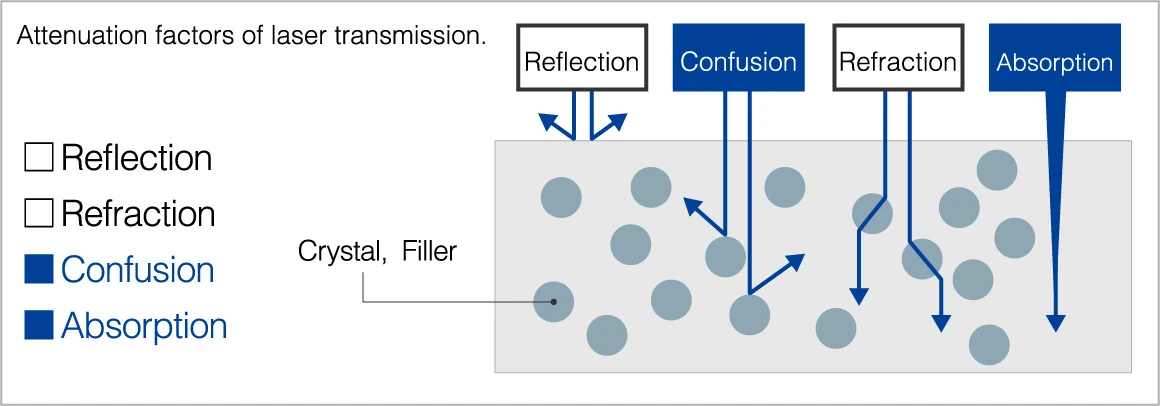
Image of laser attenuation in crystalline resin
In crystalline resins, laser light hits the internal crystals and is reflected, scattered, and refracted, making it difficult to use as a transmitting material in laser welding. Also, even when compounds (fillers) such as carbon fibers are added, the laser transmittance becomes low similarly.
Product Lineup
TORELINA™ A602LX01
It is a PPS resin that realizes high laser transmittance by controlling the crystallinity of PPS resin, which has high heat resistance and chemical resistance, and optimizing the reinforcing material. Compared to general PPS, the transmitting material can be made thicker, which not only increases the degree of design flexibility but also improves the accuracy of laser welding. This is a material that also contributes to reducing component defects.
Applications
- ・Water electrolysis equipment
- ・Electric expansion valves
- ・Rotation sensors
- ・Electric water pumps
TORAYCON™ 1251G-30 HL
It is a PBT resin suitable for laser welding, realized by Toray's technology. By controlling crystallinity, it not only improves laser transmittance but also alleviates shrinkage during molding, which is a difficulty with crystalline resins. Furthermore, by adopting a special colorant, it has made laser welding possible even in the case of dark colors. Also, although PBT generally decreases in strength due to hydrolysis in high-temperature and high-humidity environments, this product also prevents strength decrease through hydrolysis resistance technology.
Applications
- ・Speed sensors (Automotive)
- ・Automotive antenna components
- ・RFID housings
- ・Actuator cases
Introduction Support
We possess a galvano-scanning type laser welding laboratory machine, and can conduct shear strength measurements of actually welded test pieces and airtightness confirmation tests of box-shaped test pieces. Utilizing compound development technology and CAE analysis technology, we can conduct analysis and make proposals regarding laser welding of resins from various angles.
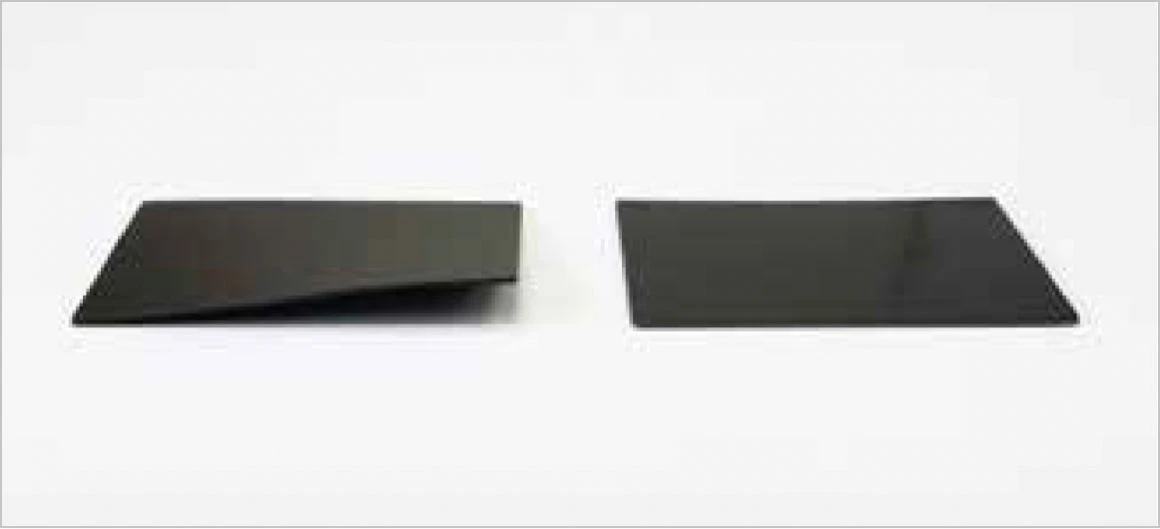
Comparison of warpage of PBT
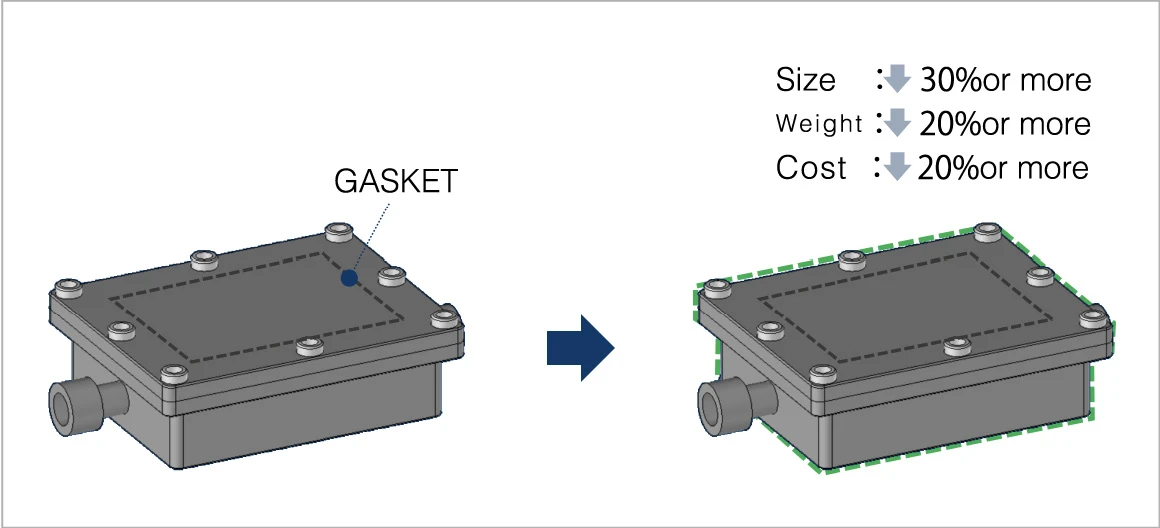
Elimination of bolts through laser welding
Attracting attention for "waterproof x vibrationless x short takt time" What are PBT and PPS resins suitable for the laser welding method?
In the manufacturing of increasingly highly functional device components these days, a process of joining thermoplastic resins with high quality and high efficiency is required. We introduce PBT and PPS materials that become higher quality and more efficient in the laser welding method, which has no effect on built-in precision elements and shortens the takt time.
Realizing laser welding of high-performance resins Specific usage methods and characteristics of PBT and PPS for laser welding
Laser welding of thermoplastic resins is expected to be a method that improves the productivity and quality of component manufacturing. We will explain specific methods when using PBT or PPS for laser welding, and the characteristics of the components obtained thereby.
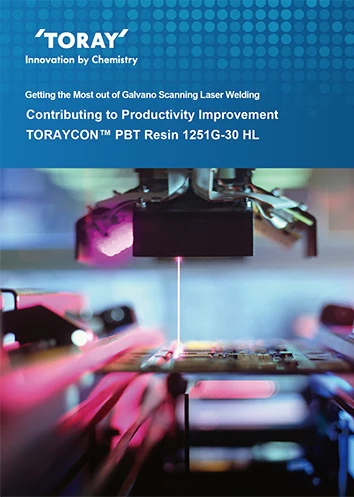
Maximizing the features of galvano-scanning laser welding PBT resin TORAYCON™ 1251G-30 HL contributing to productivity improvement
In recent years, the adoption of galvano-scanning type laser welding, which has high welding quality, is expanding as a joining method for automotive components. Toray has developed a highly laser-transmitting PBT resin, TORAYCON™ 1251G-30 HL, which is optimal for galvano-scanning laser welding while maintaining the characteristics of PBT resin.
Related Information
TORELINA™ PPS resin

TORAYCON™ PBT resin

Articles you may also be interested in
EMC countermeasures using Carbon Fiber Reinforced Thermoplastic (CFRTP)
with
excellent electromagnetic shielding properties
Mobility xEV Downsizing Space saving Power equipment Insulation measures
PPS resin with excellent tracking resistance that shortens creepage distance under high voltage
Mobility xEV Downsizing Space saving Power equipment Insulation measures